The cranial nerves are 12 pairs of nerves that can
be seen on the ventral (bottom) surface of the brain. Some of these nerves
bring information from the sense organs to the brain; other cranial nerves
control muscles; other cranial nerves are connected to glands or internal
organs such as the heart and lungs.
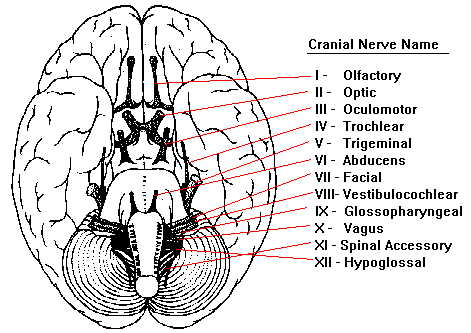
Can't remember the names of the cranial nerves?
Here is a handy-dandy mnemonic for you:
- On Old Olympus Towering Top A Famous Vocal German Viewed Some Hops.

The bold letters stand for:
olfactory, optic, oculomotor, trochlear,
trigeminal, abducens, facial, vestibulocochlear, glossopharyngeal, vagus,
spinal accessory, hypoglossal.


Test Your Cranial Nerves
Now that you know the names and functions of the
cranial nerves, let's test them. These tests will help you understand how the
cranial nerves work. These tests are not meant to be a "clinical
examination" of the cranial nerves.
You will need to get a partner to help...both of
you can serve as the experimenter (tester) and the subject. Record your
observations of what your partner does and says.
Olfactory Nerve (I)
Gather some items with distinctive smells (for
example, cloves, lemon, chocolate or coffee). Have your partner smell the items
one at a time with each nostril. Have your partner record what the item is and
the strength of the odor. Now you be the one who smells the items...have your
partner use different smells for you.
Optic Nerve (II)
Make an eye chart (a "Snellen Chart")
like the one on the right. It doesn't have to be perfect. Have your partner try
to read the lines at various distances away from the chart.
Oculomotor Nerve (III),
Trochlear Nerve (IV) and Abducens Nerve (VI)
These three nerves control eye movement and pupil
diameter. Hold up a finger in front of your partner. Tell your partner to hold
his or her head still and to follow your finger, then move your finger up and
down, right and left. Do your partner's eyes follow your fingers?
Check the pupillary response (oculomotor nerve):
look at the diameter of your partner's eyes in dim light and also in bright
light. Check for differences in the sizes of the right and left pupils.
Trigeminal Nerve (V)
The trigeminal nerve has both sensory and motor
functions. To test the motor part of the nerve, tell your partner to close his
or her jaws as if he or she was biting down on a piece of gum.
To test the sensory part of the trigeminal nerve,
lightly touch various parts of your partner's face with piece of cotton or a
blunt object. Be careful not to touch your partner's eyes. Although much of the
mouth and teeth are innervated by the trigeminal nerve, don't put anything into
your subject's mouth.
Facial Nerve (VII)
The motor part of the facial nerve can be tested by
asking your partner to smile or frown or make funny faces. The sensory part of
the facial nerve is responsible for taste on the front part of the tongue. You
could try a few drops of sweet or salty water on this part of the tongue and
see if your partner can taste it.
Vestibulocochlear Nerve
(VIII)
Although the vestibulocochlear nerve is responsible
for hearing and balance, we will only test the hearing portion of the nerve
here. Have your partner close his or her eyes and determine the distance at
which he or she can hear the ticking of a clock or stopwatch.
Glossopharyngeal Nerve
(IX) and Vagus Nerve (X)
Have your partner drink some water and observe the
swallowing reflex. Also the glossopharyngeal nerve is responsible for taste on
the back part of the tongue. You could try a few drops of salty (or sugar)
water on this part of the tongue and see if your partner can taste it.
Spinal Accessory Nerve
(XI)
To test the strength of the muscles used in head
movement, put you hands on the sides of your partner's head. Tell your partner
to move his or her head from side to side. Apply only light pressure when the
head is moved.
Hypoglossal Nerve (XII)
Have your partner stick out his or her tongue and
move it side to side.
